Roof leakage is not only a surface problem. In many cases, water enters through cracks, loose layers, weak interfaces, old coatings or poorly prepared substrates. A strong waterproofing result depends on every layer: substrate preparation, crack repair, interface treatment and the final waterproof coating.
The CKS roof waterproofing solution is designed for cement-based roof surfaces, metal roofs, leakage repair and exterior wall refurbishment. By combining Rapidseal 5M, Latex G101 and Aquaseal 305, the system helps create a continuous waterproofing layer for repair and surface protection.
Where This Roof Waterproofing Solution Can Be Used
- Cement-based roof surfaces that require leakage repair or waterproofing renewal.
- Metal roof areas that need surface protection and waterproofing maintenance.
- Roof leakage repair projects where cracks, weak surfaces or old coating failure are present.
- Exterior wall refurbishment where water seepage and surface deterioration need to be controlled.
Recommended CKS System
| Layer / Step |
Product |
Function |
| Crack repair |
Rapidseal 5M |
Repairs opened cracks before the waterproofing system is applied. |
| Interface treatment |
Latex G101 |
Improves substrate treatment and helps prepare the surface for waterproofing coating. |
| Waterproofing layer |
Aquaseal 305 |
Ready-to-use waterproof coating applied by roller or brush in two coats. |
Application Process
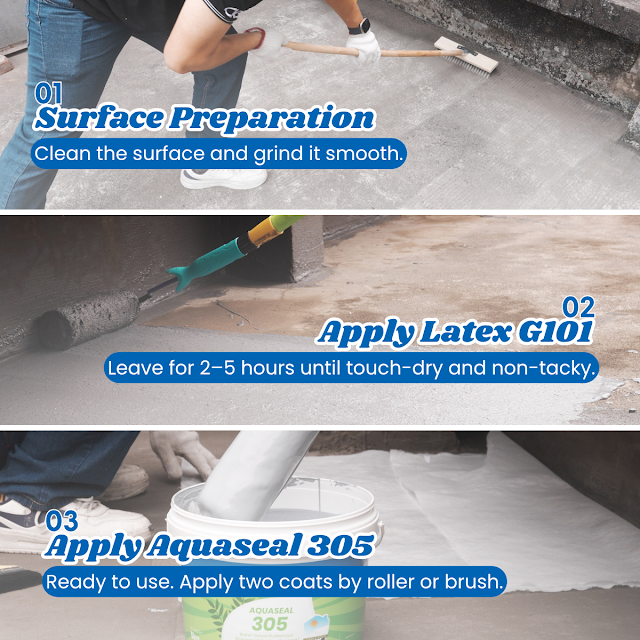
Step 1: Substrate Preparation
Clean the substrate before any repair or coating work starts. Remove floating dust, dirt and other loose materials. Loose layers should be removed, raised or uneven areas should be ground down, and the surface should be washed clean and left to dry until there is no standing water.
Grinding can be done manually or mechanically, depending on the project size and substrate condition. After grinding, remove dust thoroughly so the following repair and coating layers can bond to a clean surface.
If cracks are found, open the crack to enlarge the repair area, then pre-wet the substrate. Mix Rapidseal 5M according to the recommended project ratio: water-to-material ratio 0.25–0.30:1 by weight. Fill the groove, press the material firmly into the crack, and mist-cure the repaired area after initial setting.
Step 2: Latex G101 Interface Treatment
Pre-wet the substrate with water before applying Latex G101. Sweep away local water accumulation and avoid over-wetting. The surface should be damp but should not have visible standing water.
Mix Latex G101 according to the ratio of liquid material : powder material = 1 bag : 1 bag. Use an electric mixer until a uniform slurry is formed. Let the mixture stand for 5 minutes before application.
Apply Latex G101 evenly by brush or roller. Recommended consumption: 1 kg/m². Allow 2–5 hours of curing until the surface is dry to touch and no longer tacky.
Step 3: Aquaseal 305 Waterproofing Application
Aquaseal 305 is ready to use after opening. If there is any settlement in the bucket, stir it briefly until the coating becomes uniform.
Apply the first coat by roller or brush at approximately 0.5 kg/m². After the first coat dries for 2–4 hours, apply the second coat evenly at approximately 0.3 kg/m². Make sure the coating is continuous, uniform and free from missed areas.
Important Application Tips
- Do not skip substrate cleaning. Dust, loose layers and standing water can reduce adhesion and shorten the service life of the waterproofing layer.
- Treat cracks before coating. Coating over open cracks without repair may lead to repeated leakage.
- Avoid over-wetting before Latex G101. The substrate can be damp, but water should not collect on the surface.
- Apply Aquaseal 305 in two coats to form a more continuous waterproofing layer.
- For actual projects, always check the latest product Technical Data Sheet and packaging instructions before application.
Frequently Asked Questions
Can this system be used on both cement roofs and metal roofs?
Yes. This solution is designed for cement-based surfaces, metal roof areas, leakage repair and exterior wall refurbishment. The substrate condition should be checked before application.
Can Aquaseal 305 be applied directly without surface preparation?
No. The surface should be clean, solid and free from dust, loose layers and standing water. Cracks should be repaired before waterproofing.
Why is Latex G101 applied before Aquaseal 305?
Latex G101 acts as an interface treatment layer. It helps prepare the substrate before the waterproofing coating is applied.
How long should I wait before applying the second coat of Aquaseal 305?
Normally, the second coat can be applied after the first coat dries for 2–4 hours, depending on site conditions.
What is the recommended consumption for this system?
Latex G101: approximately 1 kg/m².
Aquaseal 305: approximately 0.5 kg/m² for the first coat and 0.3 kg/m² for the second coat.
Build a Stronger Waterproofing Layer with CKS
For roof waterproofing, every layer matters. From substrate treatment to final coating, the CKS roof waterproofing system helps provide reliable surface protection for leakage repair and refurbishment projects.Need help choosing the right waterproofing solution for your roof, wall or repair project? Contact CKS for product guidance, application support and system recommendations.