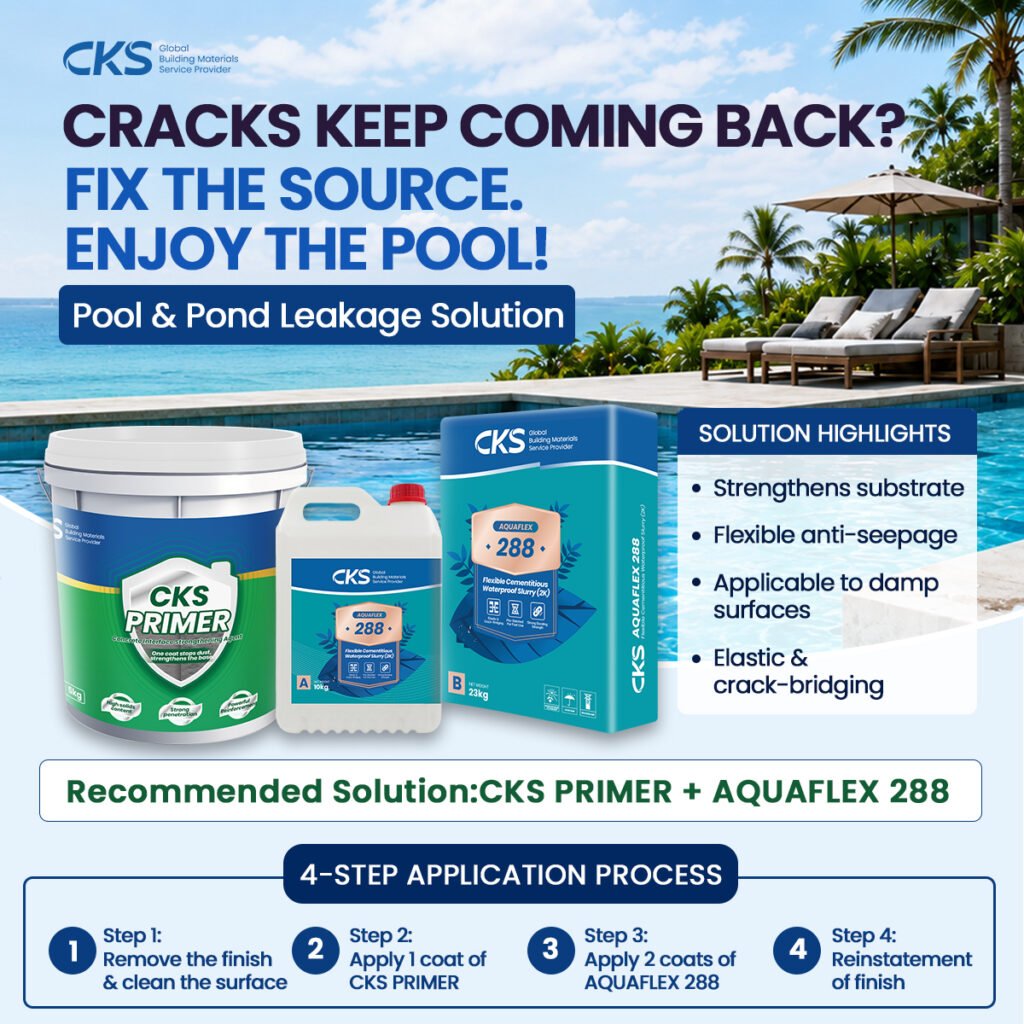
Cracks keep coming back? Fix the source. Enjoy the pool! A leaking swimming pool or pond is more than an inconvenience. Water loss can affect operating costs, damage nearby finishes and structures, and interrupt the use of a residential or commercial water feature. When a repair fails repeatedly, simply covering the visible crack may not be enough. The substrate, the condition of the existing finish, the waterproofing layer and the details around pipes or fittings all need to be checked.
For suitable pool and pond repair projects, CKS recommends a system combining CKS Primer Concrete Interface Strengthening Agent with Aquaflex 288 Flexible Cementitious Waterproof Slurry (2K). CKS Primer helps reinforce and seal suitable weak or dusty substrates, while Aquaflex 288 forms a flexible, high-strength waterproof coating with good adhesion and impermeability. Used as part of a properly prepared and specified repair, the system helps reduce the risk of recurring seepage.
Why Do Pool and Pond Leaks Keep Coming Back?
A recurring leak can have more than one cause. Before selecting a waterproofing material, identify where the water is escaping and what is allowing it to pass through. Common issues include:
· Weak or dusty substrate. Loose cement-sand mortar, powdery concrete or poorly bonded old layers can prevent a new coating from adhering reliably.
· Cracks and local defects. Fine cracks, pinholes, honeycombing or damaged areas can create paths for water. Cracks caused by structural movement need a different level of assessment from stable surface cracks.
· Failed interfaces and details. Corners, pipe penetrations, drains, fittings and construction joints can be vulnerable if they were not properly detailed or have deteriorated.
· Inadequate surface preparation. Dust, algae, loose finishes, laitance and other contaminants can weaken the bond between the substrate and the waterproofing layer.
· Incorrect application or curing. Uneven coverage, incorrect mixing, insufficient coating build or putting the pool back into service before the system has cured can compromise performance.
It is also important to confirm that the water loss is caused by the pool shell or pond structure rather than evaporation, plumbing, fittings or circulation equipment. Where the source is uncertain, isolate and inspect relevant systems or consult a qualified pool professional before starting the waterproofing work. Active structural cracks, moving joints and significant displacement should be assessed and treated with an appropriate repair design; a surface coating alone should not be relied on to resolve structural movement.
Recommended System: CKS Primer + Aquaflex 288
The CKS Pool & Pond Leakage Solution pairs substrate reinforcement with flexible cementitious waterproofing. The two products serve different purposes and should be applied in the correct sequence, following the current product technical data sheets and the project specification.
1. CKS Primer — Concrete Interface Strengthening Agent
CKS Primer is a ready-to-use, high-penetration bonding agent formulated with polymer emulsion and multifunctional additives. Its high solids content helps control dust, bind sandy particles and improve adhesion. Its penetration and reinforcement action can help increase the density of suitable weak substrates before waterproofing or tile installation.
· Helps control dust and bind loose or sandy surface particles.
· Penetrates into suitable substrates to provide deeper reinforcement.
· Ready to use and straightforward to apply.
· Suitable for concrete, aerated concrete, plastering layers and loose sand-cement surfaces when used as specified.
2. Aquaflex 288 — Flexible Cementitious Waterproof Slurry (2K)
Aquaflex 288 is a two-component flexible cementitious waterproof slurry composed of acrylate emulsion, cement and inorganic powders. It is a water-based material with good adhesion, high film strength, ductility and impermeability. Its flexibility helps accommodate minor movement and bridge fine cracks within the limits of the approved system; it is not a substitute for repairing structural or actively moving cracks.
· Good waterproofing performance with a cost-conscious system design.
· Water-based formulation.
· High film strength and good ductility.
· Strong bonding and impermeability.
· Can be applied to a damp substrate, provided there is no standing or floating water and the technical instructions are followed.
Key Benefits for Pool and Pond Repair
· Strengthens the substrate. CKS Primer helps reinforce suitable dusty, sandy or weak surface layers so the waterproofing system has a better-prepared base.
· Flexible anti-seepage protection. Aquaflex 288 forms a flexible cementitious coating with good film strength and impermeability to help resist water penetration.
· Suitable for damp surfaces. The coating can be applied to a damp substrate without standing water, which can be useful in repair settings where the base cannot be completely dry. Surface conditions must still meet the product requirements.
· Helps address fine cracking. Its ductility and flexible nature can help accommodate minor movement and bridge fine cracks when the substrate and crack conditions are suitable.
Where Can This Solution Be Used?
The recommended system is intended for suitable waterproofing and anti-seepage work in swimming pools, landscape ponds and other pool-type wet areas. Aquaflex 288 is also specified for waterproofing kitchens and bathrooms. CKS Primer can be used for interface reinforcement on appropriate concrete, aerated concrete, plaster and sand-cement substrates before waterproofing or tile installation.
Actual suitability depends on the pool design, substrate condition, exposure, water chemistry, finish system and project requirements. For permanently submerged applications, confirm compatibility with the complete system—including any tile adhesive, grout, repair mortar and finish—with CKS technical support before work begins.
4-Step Application Process
Step 1 — Remove the finishes and clean the surface
Remove loose or damaged tiles and finishes in the repair area. Eliminate dust, algae, laitance, oil, loose mortar and other contaminants. Inspect the exposed substrate and identify cracks, voids, weak patches, pipe penetrations and other details. Repair defects with a compatible repair material selected for the substrate and the type of crack. Structural cracks or moving joints require a suitable specialist detail rather than simple surface filling.
Step 2 — Apply one coat of CKS Primer
Apply CKS Primer evenly to the prepared substrate in accordance with its product instructions. The primer is ready to use; do not dilute it unless the current technical data sheet specifically permits dilution. Ensure the surface is adequately covered and allow the primer to dry or penetrate as directed before proceeding. Highly absorbent or unusually weak substrates may require technical assessment.
Step 3 — Apply two coats of Aquaflex 288
Prepare and mix the two components in the specified ratio and manner. Apply the first coat evenly, paying attention to corners, edges, penetrations and repaired areas. After the first coat has reached the required condition for recoating, apply the second coat to achieve continuous coverage. Follow the technical data sheet for mixing time, pot life, application rate, total coating thickness and recoat interval. The substrate may be damp, but it must not have standing or floating water.
Step 4 — Reinstate the finishes
Protect the waterproofing layer while it cures. Once the system has fully cured for the conditions and exposure specified by CKS, complete the compatible finish system, such as tiles or mosaics. Before refilling or returning the pool or pond to service, carry out the required inspection and water-retention test in accordance with the product instructions and project specification. Do not assume that the coating is ready for immersion simply because it feels dry to the touch.
Important Checks Before the Pool Is Refilled
· Confirm the source of leakage and check plumbing, fittings and circulation equipment where relevant.
· Make sure the substrate is sound, clean and free of loose finishes or contaminants.
· Use compatible repair materials for cracks, corners, joints and penetrations.
· Follow the product data sheets for mixing ratio, coverage, coating thickness, drying, curing and recoat times.
· Confirm compatibility with the intended tile adhesive, grout and finish system.
· Complete the specified curing period and water-retention test before immersion or service.
Frequently Asked Questions
Can Aquaflex 288 be applied to a damp pool surface?
Yes, Aquaflex 288 can be applied to a damp substrate, provided there is no standing or floating water and the surface meets the product's application requirements.
Why is CKS Primer used before Aquaflex 288?
CKS Primer helps control dust, bind sandy particles and reinforce suitable weak substrates. A properly prepared base supports better adhesion of the waterproofing system.
Can the system be used in swimming pools and landscape ponds?
The system is recommended for suitable pool and pond waterproofing and anti-seepage applications. Confirm compatibility with the specific pool design, long-term immersion conditions, water chemistry and finish system before use.
Choose a System That Addresses the Source
A lasting pool or pond repair starts with diagnosis, not simply covering the visible leak. Check the substrate, repair defects appropriately, reinforce suitable weak surfaces with CKS Primer, and apply Aquaflex 288 as a continuous flexible waterproofing layer in accordance with the product instructions. For recurring leakage, complex details or permanently submerged applications, involve a qualified waterproofing contractor or consult CKS technical support to confirm the repair design and full system compatibility.
Need help selecting a pool or pond waterproofing system? Contact CKS for product guidance and project-specific recommendations.