Roof leakage is one of the most common waterproofing problems in homes, commercial buildings and renovation projects. In tropical weather, roofs are exposed to heavy rain, strong sunlight, temperature movement and surface ageing. Once cracks, loose layers or weak adhesion appear, water can easily enter the roof structure and lead to ceiling stains, wall dampness, peeling paint and repeated repair costs.
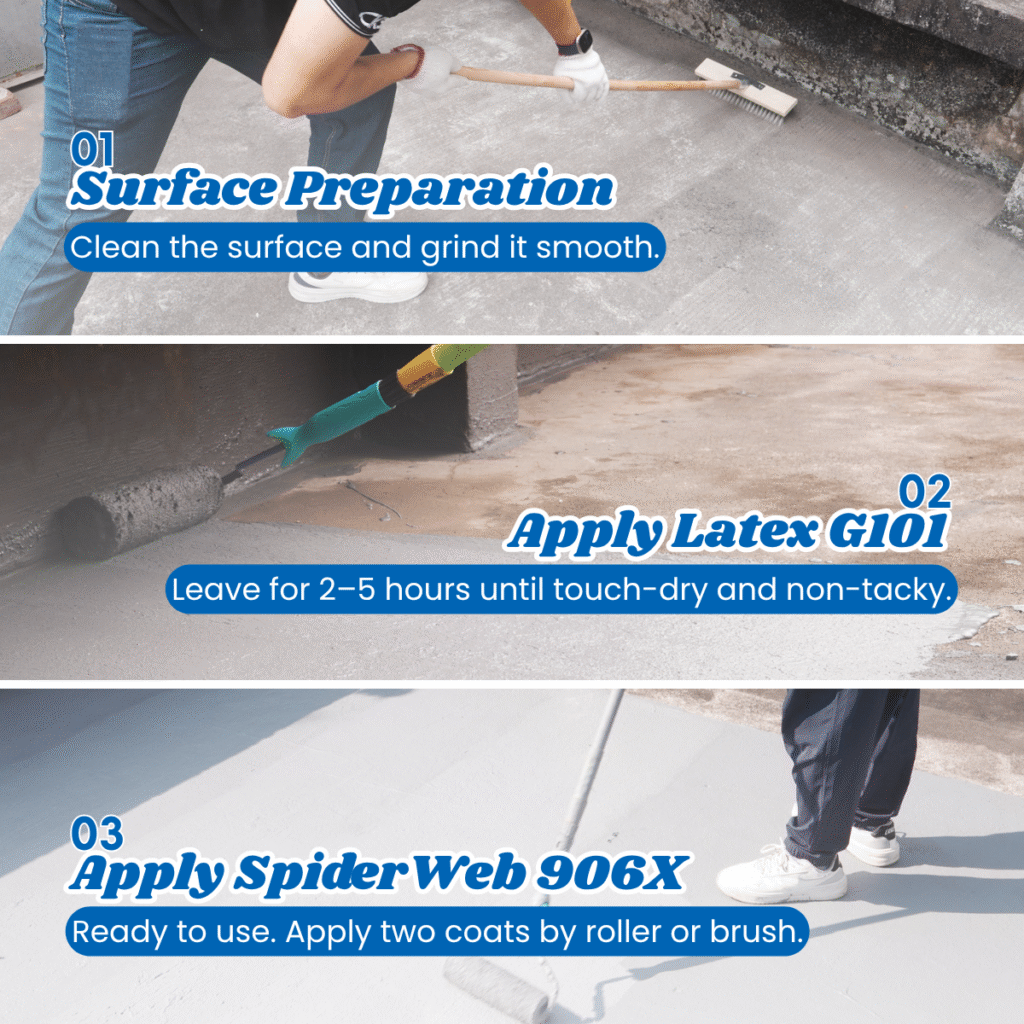
CKS roof waterproofing solution is designed for cement-based roof surfaces, metal roofs, roof leakage repair and exterior wall renovation. The system focuses on three key actions: preparing a clean and stable substrate, improving the bonding layer with Latex G101, and applying CKS Spiderweb 906X as the waterproof coating layer.
Where This Roof Waterproofing Solution Can Be Used
- Concrete or cement-based roof surfaces that need waterproofing or re-waterproofing.
- Metal roofs with leakage points, surface ageing or waterproofing repair needs.
- Roof leakage repair where cracks, loose layers or weak areas must be treated before coating.
- Exterior wall renovation areas that require waterproofing support before repainting or finishing.
Important note: This solution is suitable for non-structural waterproofing repair and renovation. If the roof has serious structural cracks, severe movement, unstable substrate or long-term ponding water, a professional site inspection is recommended before product application.
Why Roof Waterproofing Fails
Many roof waterproofing failures happen because the coating is applied too quickly without solving the real surface problems. Common causes include:
- Dust, cement laitance, oil, old weak coating or loose particles left on the roof surface.
- Cracks not opened, cleaned and repaired before waterproofing.
- The substrate is over-wet, with visible water or puddles before coating.
- No primer or bonding layer is used on a porous or weak surface.
- The waterproof coating is applied too thinly, unevenly or with missed areas.
- The second coat is applied before the first coat has dried sufficiently.
CKS Roof Waterproofing System Overview
| Step |
System Layer |
Main Function |
| 1 |
Surface Preparation |
Clean the roof surface, remove loose layers, grind raised areas, rinse and allow the surface to dry until there is no visible water. Cracks should be opened and repaired with Rapidseal 5M. |
| 2 |
Latex G101 / Interface Layer |
Dampen the substrate without leaving standing water. Mix liquid and powder at 1 bag : 1 bag, stir evenly, rest for 5 minutes and apply by brush or roller. |
| 3 |
CKS Spiderweb 906X Waterproof Coating |
Ready-to-use waterproof coating applied by roller or brush in two coats. Stir before use if settlement appears after opening the pail. |
Step 1: Surface Preparation
Good substrate preparation is the foundation of roof waterproofing. Before applying any primer or waterproofing coating, the roof surface should be clean, firm and free from loose material.
- Remove floating dust, sand, dirt, debris and other surface contaminants.
- Scrape off loose layers, weak coatings and unstable materials.
- Grind raised or uneven areas by hand grinding or mechanical grinding.
- Rinse the surface and allow it to dry until there is no visible standing water.
- Clean off dust again after grinding to avoid poor adhesion.
If cracks are found on the substrate, they should be opened and enlarged before repair. After opening the crack, dampen the substrate and fill it with Rapidseal 5M. Press the material firmly into the crack to avoid voids. After the material starts to set, apply water curing according to site conditions and approved technical requirements.
- Open and enlarge visible cracks before repair.
- Dampen the repair area after cutting or grooving.
- Mix Rapidseal 5M according to approved project instruction: water-to-material ratio 1:0.25–0.3 by weight.
- Fill and compact the repair material firmly into the crack or groove.
- After initial setting, maintain curing by light water spraying where required.
Step 2: Latex G101 Interface Layer
After surface preparation and crack repair, apply Latex G101 as the interface layer. This step helps improve bonding between the substrate and the following waterproofing layer.
- Dampen the substrate with clean water before application.
- Remove local water accumulation. Do not over-wet the surface or leave visible standing water.
- Mix Latex G101 at liquid : powder = 1 bag : 1 bag.
- Use an electric mixer until a uniform slurry is formed.
- Allow the mixed slurry to rest for about 5 minutes before use.
- Apply evenly by brush or roller.
- Recommended consumption: about 1 kg/m², subject to substrate roughness and absorption.
- Allow 2–5 hours of curing until the surface is dry to touch and not sticky.
CKS Spiderweb 906X is applied as the waterproof coating layer. The product is ready to use after opening the pail. If settlement is observed, stir it gently until uniform before application.
- Apply the first coat evenly by roller or brush.
- Recommended first coat consumption: 0.6 kg/m².
- Allow the first coat to dry for about 2–4 hours, depending on site temperature, ventilation and humidity.
- Apply the second coat evenly after the first coat has dried sufficiently.
- Recommended second coat consumption: 0.4 kg/m².
- Make sure the waterproof coating is continuous, uniform and free from missed areas.
Common Mistakes to Avoid
- Applying waterproof coating directly over dust, oil, loose layers or old peeling coatings.
- Skipping crack repair and expecting the coating alone to stop active cracks.
- Leaving puddles or visible water on the substrate before primer or coating application.
- Using the product without stirring when settlement is visible after opening the pail.
- Applying the second coat too early before the first coat is sufficiently dry.
- Applying too little material and creating a thin, discontinuous waterproof layer.
- Ignoring roof drainage and allowing long-term ponding water to remain on the surface.
FAQ: Roof Waterproofing and Leakage Repair
Can this roof waterproofing solution be used on both concrete and metal roofs?
Yes. The system is designed for cement-based roof surfaces, metal roofs, leakage repair and exterior wall renovation. The application method may vary according to substrate condition, so surface inspection is important before application.
Why is surface preparation important before waterproofing?
Waterproof coatings need a clean and stable surface to bond properly. Dust, loose particles, old weak coating and standing water can reduce adhesion and lead to peeling or leakage recurrence.
Do I need to repair cracks before applying waterproof coating?
Yes. Visible cracks should be opened, cleaned, dampened and repaired with Rapidseal 5M before the primer and waterproof coating are applied.
Should the roof surface be wet or dry before Latex G101?
The substrate should be dampened, but there should be no visible standing water or puddles. Over-wetting can affect application and bonding.
How many coats of CKS Spiderweb 906X are recommended?
Two coats are recommended. The first coat consumption is about 0.6 kg/m² and the second coat consumption is about 0.4 kg/m², depending on substrate roughness and site condition.
How long should I wait before applying the second coat?
Allow the first coat to dry for about 2–4 hours before applying the second coat. Actual drying time depends on temperature, humidity, ventilation and coating thickness.
Can I apply waterproof coating during rain?
No. Avoid application during rain or when rain is expected before the coating has dried sufficiently. A wet surface or fresh rain can affect film formation and adhesion.
Can this system be used for exterior wall renovation?
Yes. It can support exterior wall renovation where waterproofing treatment is needed, especially for cracks, weak surface layers or water seepage-prone areas.
Need Help Choosing the Right Roof Waterproofing System?
If you are dealing with roof leakage, old waterproofing failure or exterior wall seepage, contact CKS for product recommendation and application guidance. Share photos of the leaking area, substrate type, roof size and current surface condition so our team can help recommend a suitable solution.